


AI & SEO 2026: The Impact of Artificial Intelligence on Modern Search
Search is no longer what it used to be.
A few years ago, ranking on Google was primarily about keywords, backlinks, and optimizing pages for Search Engine Optimization. Today, artificial intelligence is fundamentally transforming how search works from how results are generated to how users consume information.
Instead of browsing multiple websites, users are now getting:
-
Instant answers generated by AI
-
Summarized insights from multiple sources
-
Personalized results based on intent and behavior
This shift is driven by advancements such as Google AI Overviews, conversational search platforms, and machine learning systems that understand context rather than just keywords.
This is where AI SEO becomes essential for modern digital marketing strategies.
In this guide, you will learn:
-
What AI SEO means in today’s landscape
-
The role of artificial intelligence in reshaping SEO practices
-
A practical AI SEO strategy you can implement
-
Real-world examples to better understand its impact
What is AI SEO?
Simple Definition
AI SEO is the process of optimizing your content writing so it can be discovered, understood, and selected by AI-powered search engines and platforms.
Unlike traditional SEO, which primarily focuses on rankings, AI SEO emphasizes:
-
Visibility within AI-generated answers
-
Content clarity and extractability
-
Entity recognition and trust signals
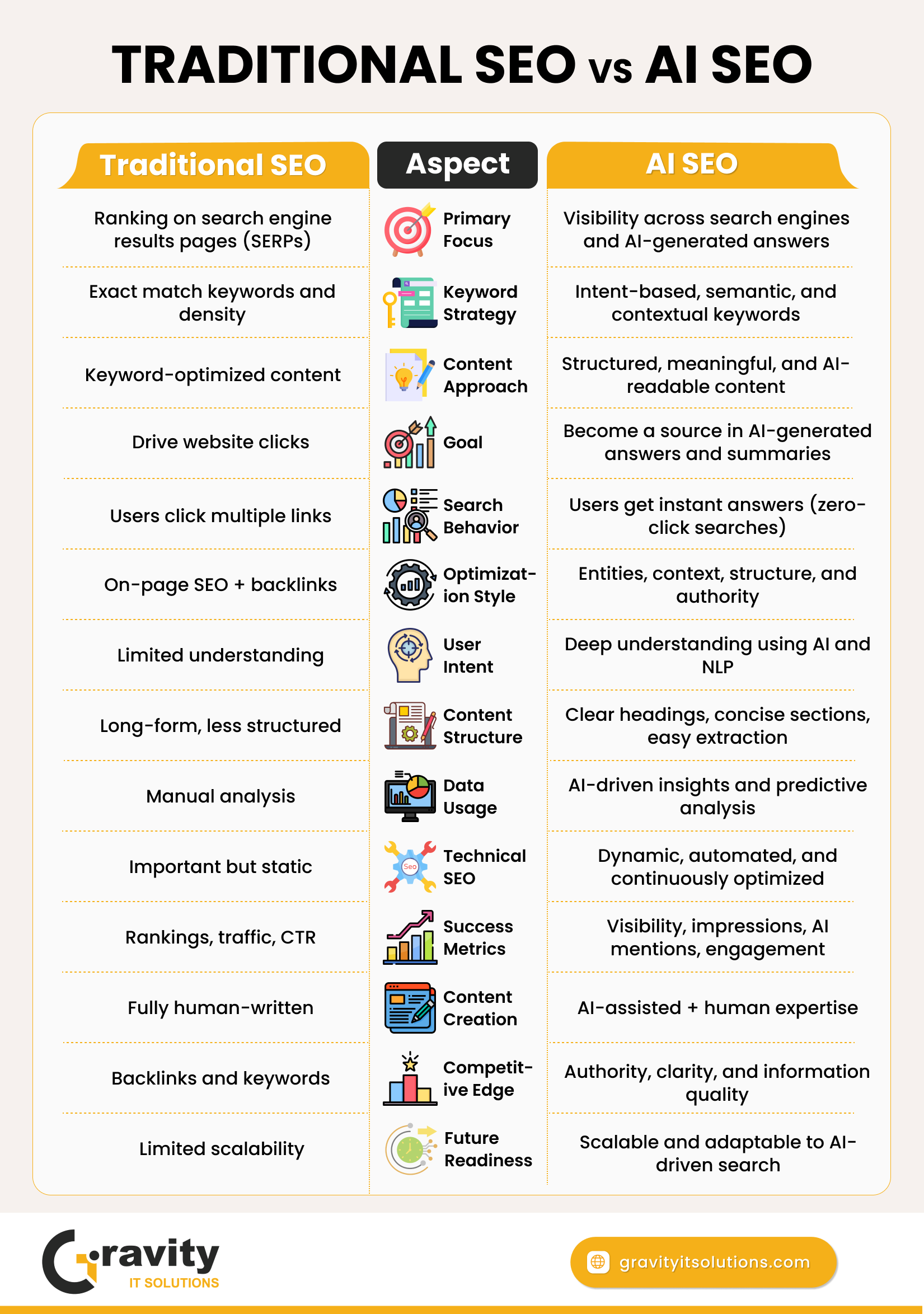
Traditional SEO vs AI SEO
|
Factor |
Traditional SEO |
AI SEO |
|
Focus |
Ranking on search engine results pages |
Visibility across AI and search platforms |
|
Keywords |
Exact match and density |
Intent, context, and semantics |
|
Content |
Keyword-optimized content |
Structured, meaningful, and informative content |
|
Goal |
Drive clicks |
Become a trusted source in AI-generated answers |
Example to Understand the Difference
Search Query: “Best diet for weight loss”
Traditional SEO approach:
Users are shown a list of search results and typically click on multiple websites to find relevant information.
AI-driven search approach:
Search engines provide a summarized answer generated from multiple sources, often reducing the need to visit individual websites.
If your content is clear, structured, and authoritative, it has a higher chance of being included in these AI-generated responses.
Advanced Understanding
AI SEO extends beyond traditional optimization techniques. It includes:
-
Generative AI SEO: Optimizing content for AI-generated summaries and responses
-
Answer Engine Optimization (AEO): Structuring content to appear in direct answers
-
Entity SEO: Helping AI systems clearly understand topics, brands, and relationships
In simple terms, SEO was about ranking pages, while AI SEO is about becoming the source of answers.
Why AI is Changing Search Forever
Artificial intelligence is not just improving search — it is redefining how it works.
Search engines are evolving from simple information retrieval systems into intelligent platforms that can understand, interpret, and generate answers in real time. This transformation is fundamentally changing how users interact with search and how businesses need to approach SEO.
From Traditional Search Listings to Instant Answers
Traditionally, search engines displayed a list of links, leaving users to explore multiple websites to find the information they needed.
Today, AI-powered systems can:
-
Analyze multiple sources instantly
-
Combine information into a single, clear response
-
Deliver answers directly on the search results page
This means users are increasingly getting what they need without clicking on any website.
Rise of AI-Powered Search Experiences
Modern search is being shaped by AI-driven features such as:
-
Google’s AI Overviews now deliver concise summaries directly at the top of search pages
-
Conversational search tools that allow users to ask follow-up questions
-
AI assistants that generate responses based on multiple data sources
These systems focus on delivering accurate, context-aware answers rather than just listing relevant pages.
The Growth of Zero-Click Searches
One of the biggest impacts of AI in search is the rise of zero-click searches.
A zero-click search occurs when users find their answer directly on the search results page without visiting any website.
This is becoming more common because:
-
AI summaries provide complete answers
-
Featured snippets and knowledge panels deliver quick information
-
Users prefer faster, more convenient experiences
This means simply appearing on page one is no longer sufficient for visibility. Visibility within AI-generated results is becoming equally important.
From Keywords to Intent and Context
AI has significantly improved how search engines understand user intent.
Instead of matching exact keywords, AI systems analyze:
-
The meaning behind a query
-
User behavior and preferences
-
Context of previous searches
For example, a search for “best laptop for students” is no longer treated as just a keyword phrase. AI understands that the user is looking for recommendations based on budget, performance, and use case.
This shift requires content that is:
-
More informative and comprehensive
-
Written in natural language
-
Focused on solving user problems
Example: How Search Behavior Has Changed
Consider the query: “How to improve website traffic”
Previously, users would:
-
Click multiple blog posts
-
Compare different strategies
-
Spend time researching
Now, AI-driven search can:
-
Provide a summarized list of strategies
-
Highlight key recommendations
-
Offer step-by-step guidance instantly
If your content is well-structured and authoritative, it can be included in these summaries, increasing visibility even without a click.
What This Means for Businesses
The impact of AI on search is clear:
-
Visibility is no longer limited to rankings
-
Content must be optimized for both users and AI systems
-
Authority, clarity, and structure are more important than ever
Businesses that adapt to these changes can gain a competitive advantage by appearing in AI-generated answers and maintaining strong visibility across evolving search platforms.
SEO Evolution: Moving Beyond Keywords to AI-Powered Approaches
Search engine optimization has undergone a significant transformation over the years. What started as a keyword-focused practice has evolved into a sophisticated, AI-driven discipline centered around user intent, context, and content quality.
Understanding this evolution is essential to adapting your strategy for modern search environments.
The Era of Traditional SEO (Keyword-Focused)
In its early stages, SEO was largely based on keyword optimization.
The primary goal was to rank for specific search terms by:
-
Using exact-match keywords throughout the content
-
Optimizing meta tags and headings
-
Building backlinks with keyword-rich anchor text
This approach worked because search engines relied heavily on keyword matching to determine relevance.
However, it often led to:
-
Keyword stuffing
-
Low-quality, repetitive content
-
Poor user experience
Search engines eventually began to move away from this model as user expectations evolved.
The Shift to Intent-Based SEO
As search engines became more advanced, they started focusing on understanding user intent rather than just matching keywords.
With the introduction of machine learning and natural language processing, search engines began to:
-
Interpret the meaning behind queries
-
Analyze user behavior and engagement
-
Deliver results based on relevance, not just keywords
This marked the transition to intent-based SEO.
Content strategies shifted toward:
-
Answering specific user questions
-
Providing in-depth, valuable information
-
Creating content that aligns with different stages of the user journey
For example, instead of targeting a keyword like “SEO tips,” content began focusing on topics such as “how to improve website rankings” or “SEO strategies for small businesses.”
The Rise of AI-Driven SEO
Today, SEO has entered a new phase driven by artificial intelligence.
AI-powered systems are now capable of:
-
Understanding complex queries and context
-
Generating summarized answers from multiple sources
-
Evaluating content based on quality, structure, and authority
This has led to the emergence of AI-driven SEO, where the focus is on:
-
Creating content that is easy for AI to interpret and extract
-
Structuring information clearly with headings, lists, and concise explanations
-
Building topical authority rather than targeting isolated keywords
Example: How SEO Has Evolved
Consider the topic: “Email marketing”
Traditional SEO approach:
-
Target keyword: “email marketing tips”
-
Write a basic article with repeated keyword usage
Intent-based SEO approach:
-
Cover topics like strategy, tools, and best practices
-
Focus on solving user problems
AI-driven SEO approach:
-
Create a comprehensive guide covering all aspects of email marketing
-
Include clear definitions, step-by-step processes, and structured content
-
Ensure the content can be easily summarized and used in AI-generated answers
Key Differences Across SEO Evolution
|
Aspect |
Traditional SEO |
Intent-Based SEO |
AI-Driven SEO |
|
Focus |
Keywords |
User intent |
Context + AI understanding |
|
Content |
Optimized for search engines |
Optimized for users |
Optimized for users and AI |
|
Strategy |
Ranking pages |
Solving queries |
Becoming a trusted source |
|
Measurement |
Rankings and traffic |
Engagement and conversions |
Visibility across search + AI platforms |
What This Means for Your Strategy
The evolution of SEO highlights a clear direction:
-
Keywords alone are no longer enough
-
Content must demonstrate depth, clarity, and authority
-
Structure and context play a critical role in visibility
-
AI systems prioritize content that is easy to understand and extract
To succeed in this new landscape, businesses must adopt strategies that align with how modern search engines and AI systems process information.
How AI is Transforming SEO (Core Areas)
Artificial intelligence is not just influencing SEO at a surface level — it is transforming every core component of how optimization is planned, executed, and measured.
From keyword research to content creation and technical optimization, AI is enabling faster, smarter, and more data-driven decisions. Understanding these changes is critical for building a future-ready SEO strategy.
AI in Keyword Research
Keyword research has traditionally been a manual and time-consuming process. Marketers relied on tools to find search volume, competition, and basic keyword variations.
With AI, this process has become significantly more advanced.
AI-powered tools can now:
-
Analyze large datasets to identify emerging search trends
-
Discover long-tail and conversational queries
-
Predict future keyword opportunities based on user behavior
This allows businesses to move beyond static keyword lists and focus on dynamic, intent-driven search patterns.
Example:
Instead of targeting a broad keyword like “digital marketing,” AI tools can identify more specific and high-intent queries such as:
-
“best digital marketing strategies for small businesses”
-
“how to generate leads using SEO in the USA”
These insights help create more targeted and effective content strategies.
AI in Content Creation
Content creation is one of the most impacted areas by artificial intelligence.
AI tools can assist in:
-
Generating content ideas and outlines
-
Writing drafts and summaries
-
Optimizing content for readability and SEO
However, the real value lies in combining AI efficiency with human expertise.
AI can help scale content production, but high-quality content still requires:
-
Original insights
-
Real-world examples
-
Clear and engaging storytelling
Example:
An AI tool can generate a basic article on “SEO trends,” but a human expert enhances it by adding:
-
Case studies
-
Industry insights
-
Practical strategies
This combination results in content that is both scalable and authoritative.
AI in Search Intent Understanding
Modern search engines are designed to understand what users mean, not just what they type.
AI plays a key role in:
-
Interpreting natural language queries
-
Understanding context and user intent
-
Delivering personalized search results
This means content must align closely with what users are actually looking for.
Example:
Search query: “best CRM for startups”
AI understands that the user is likely looking for:
-
Comparisons of CRM tools
-
Pricing details
-
Features suitable for small teams
Content that directly addresses these needs is more likely to perform well.
AI in Technical SEO
Technical SEO (explained in our Technical SEO guide) has also been significantly improved by AI.
AI-driven tools can:
-
Perform automated site audits
-
Identify technical issues such as broken links and slow page speed
-
Provide actionable recommendations for optimization
This reduces manual effort and improves accuracy.
Example:
Instead of manually checking hundreds of pages, AI tools can quickly detect:
-
Crawl errors
-
Duplicate content
-
Core Web Vitals issues
This allows businesses to fix problems faster and maintain a healthy website structure.
AI in Data Analysis and Predictive SEO
One of the most powerful capabilities of AI is its ability to analyze and predict trends.
AI can:
-
Track user behavior and engagement patterns
-
Forecast traffic and ranking changes
-
Identify opportunities before competitors
This enables a more proactive approach to SEO.
Example:
AI tools can identify that a particular topic is gaining popularity and suggest creating content early, allowing businesses to capture traffic before competition increases.
AI SEO Strategy: A Step-by-Step Framework
Understanding how AI is transforming SEO is important, but real results come from applying a clear and structured strategy.
An effective AI SEO strategy focuses on creating content that is not only optimized for search engines but also easily understood, extracted, and trusted by AI systems.
Below is a practical framework you can follow to build a future-ready SEO strategy.
Step 1: Build Topical Authority
AI-driven search systems prioritize websites that demonstrate deep expertise in a specific subject.
Instead of creating isolated blog posts targeting individual keywords, focus on building comprehensive topic clusters.
How to implement:
-
Create a pillar page covering a broad topic in detail
-
Develop supporting articles that address subtopics
-
Interlink all related content to build context and authority
Example:
If your main topic is “AI SEO,” your content structure could include:
-
AI SEO guide (pillar page)
-
AI SEO tools
-
AI SEO strategy
-
Generative AI SEO
-
AI SEO for local businesses
This approach signals to search engines and AI systems that your website has strong expertise in the subject.
Step 2: Optimize for Entities, Not Just Keywords
AI systems rely heavily on entities such as brands, concepts, and relationships between topics.
Rather than focusing only on keywords, ensure your content clearly defines and connects important entities.
How to implement:
-
Clearly define key terms within your content
-
Use consistent naming for brands, tools, and concepts
-
Provide context around relationships between topics
Example:
Instead of just mentioning “SEO tools,” specify:
-
What the tool does
-
How it relates to AI SEO
-
Why it is important
This helps AI systems better understand and accurately represent your content.
Step 3: Create AI-Readable and Structured Content
AI systems prefer content that is clear, well-structured, and easy to extract.
This increases the chances of your content being included in AI-generated answers.
How to implement:
-
Use clear headings (H1, H2, H3)
-
Write concise and self-contained paragraphs
-
Include lists, tables, and step-by-step explanations
-
Add direct answers at the beginning of sections
Example:
Instead of writing long, unstructured paragraphs, break content into:
-
Definitions
-
Key points
-
Actionable steps
This improves readability for users while helping AI better understand your content.
Step 4: Focus on Generative Engine Optimization (GEO)
With the rise of AI-generated answers, optimizing for generative engines has become essential.
GEO focuses on making your content easy for AI systems to select, summarize, and cite.
How to implement:
-
Provide clear and accurate answers to common questions
-
Use factual, well-supported information
-
Structure content in a way that can be easily summarized
-
Include data, examples, and concise explanations
Example:
When targeting queries such as “What is AI SEO,” your content should clearly provide:
-
A clear definition
-
A short explanation
-
Supporting details
This increases the likelihood of your content being used in AI-generated summaries.
Step 5: Strengthen Technical SEO Foundations
Even in an AI-driven search environment, technical SEO remains critical.
Search engines and AI systems must be able to crawl, understand, and index your content efficiently.
How to implement:
-
Improve page speed and Core Web Vitals
-
Ensure mobile-friendly design
-
Fix crawl errors and broken links
-
Use structured data (schema markup)
-
Maintain a clear site architecture
Example:
A fast-loading, well-structured website is more likely to be crawled and processed effectively, improving both rankings and AI visibility.
Step 6: Measure AI Visibility, Not Just Rankings
Traditional SEO metrics such as rankings and traffic are no longer enough.
AI SEO requires a broader approach to measurement.
How to implement:
-
Track visibility in AI-generated answers
-
Monitor brand mentions across AI platforms
-
Analyze impressions and engagement, not just clicks
-
Evaluate how your content is being represented
Example:
Even if traffic does not increase immediately, appearing in AI-generated answers can improve brand awareness and influence user decisions.
Generative AI SEO: What You Must Know
As artificial intelligence continues to evolve, one of the most significant developments in search is the rise of generative AI.
Generative AI is changing how information is presented, shifting search from a list of results to synthesized answers created from multiple sources. This shift has introduced new optimization approaches that go beyond traditional SEO.
To stay competitive, it is essential to understand how generative AI impacts search and how to optimize content accordingly.
What is Generative AI SEO?
Generative AI SEO refers to optimizing content so it can be selected, summarized, and cited by AI-powered search systems.
Instead of focusing only on rankings, generative AI SEO focuses on:
-
Being included in AI-generated responses
-
Providing clear and accurate information
-
Ensuring content can be easily interpreted and reused
In this model, visibility is achieved not just through clicks, but through presence within AI-generated answers.
Key Concepts You Should Understand
Generative Engine Optimization (GEO)
Generative Engine Optimization focuses on making content suitable for AI-generated summaries.
Unlike traditional SEO, where the goal is to rank a webpage, GEO aims to ensure your content is selected as a source for AI-generated answers.
Key elements of GEO:
-
Clear and concise explanations
-
Structured content formats
-
High factual accuracy
-
Strong topical relevance
Answer Engine Optimization (AEO)
Answer Engine Optimization (AEO) is centered around delivering precise and straightforward responses to search queries.
This concept has existed for years through featured snippets, but it has become more important with AI-driven search.
Key elements of AEO:
-
Question-based content
-
FAQ sections
-
Simple and precise answers
-
Easy-to-extract information
Large Language Model Optimization (LLMO)
Large Language Model Optimization focuses on making content understandable and usable by AI models such as ChatGPT and other generative systems.
It ensures that your content:
-
Is factually accurate
-
Has clear context and meaning
-
Can be referenced reliably by AI systems
Example: How Generative AI SEO Works
Search query: “What is AI SEO?”
In a traditional search environment:
-
Users see multiple blog posts
-
They click and read different sources
In a generative AI environment:
-
The search engine provides a summarized definition
-
The answer is created using multiple sources
-
Only the most clear and authoritative content is selected
If your content includes:
-
A clear definition
-
Structured explanation
-
Accurate and trustworthy information
It is more likely to be included in that generated answer.
How Generative AI Changes Content Strategy
Generative AI requires a shift in how content is created and structured.
Content must now be:
-
Clear and self-contained
Each section should make sense independently and provide complete information. -
Structured and organized
Use headings, bullet points, and logical flow to improve readability and extractability. -
Factually accurate and trustworthy
AI systems prioritize reliable and consistent information. -
Focused on information value
Content should provide unique insights, examples, or deeper explanations.
Common Mistakes to Avoid
Many businesses struggle with generative AI SEO because they rely on outdated practices.
Common mistakes include:
-
Writing content only for keywords
-
Publishing large volumes of low-quality AI-generated content
-
Ignoring structure and readability
-
Failing to provide clear definitions and answers
These approaches reduce the chances of content being selected by AI systems.
What This Means for SEO in the USA Market
In competitive markets like the United States, where AI adoption is rapidly increasing, businesses must adapt quickly.
Success in this environment requires:
-
High-quality, authoritative content
-
Strong brand and entity presence
-
Consistent and accurate information across platforms
Companies that align their content with generative AI systems will gain a significant advantage in visibility and trust.
Best AI SEO Tools in 2026
AI-powered tools have become essential for executing effective SEO strategies. They help automate complex tasks, provide data-driven insights, and improve overall efficiency.
However, the key is not just using tools, but understanding how to use them strategically within your AI SEO framework.
Below are some of the most effective AI SEO tools in 2026 and how they contribute to different aspects of optimization.
ChatGPT
ChatGPT is widely used for content creation, ideation, and optimization.
Key uses:
-
Generating blog outlines and drafts
-
Creating content briefs
-
Improving readability and structure
-
Assisting with keyword integration
Example:
A marketer can use ChatGPT to generate a detailed outline for a blog on “AI SEO strategy,” then refine it with expert insights and real-world examples to create high-quality content.
SEMrush
SEMrush is a comprehensive SEO platform enhanced with AI capabilities.
Key uses:
-
Keyword research and competitive analysis
-
Content optimization suggestions
-
Tracking rankings and performance
-
Identifying content gaps
Example:
You can analyze competitor content and discover keyword opportunities that are not being fully utilized, helping you create more competitive and targeted content.
Ahrefs
Ahrefs is known for its strong backlink analysis and keyword research features, now improved with AI-driven insights.
Key uses:
-
Backlink analysis and link-building strategies
-
Keyword difficulty and search intent analysis
-
Content gap identification
Example:
Ahrefs can help identify high-authority websites linking to competitors, allowing you to build a more effective link-building strategy.
Surfer SEO
Surfer SEO focuses on on-page optimization using data-driven recommendations.
Key uses:
-
Content scoring and optimization
-
SERP analysis
-
Keyword usage recommendations
-
Content structure improvement
Example:
Surfer SEO can guide you on how to structure your content based on top-ranking pages, ensuring better alignment with search engine expectations.
Frase
Frase is designed to improve content research and optimization.
Key uses:
-
Generating content briefs
-
Identifying questions users are asking
-
Optimizing content for search intent
Example:
Frase can help create FAQ sections based on real user queries, improving your chances of appearing in featured snippets and AI-generated answers.
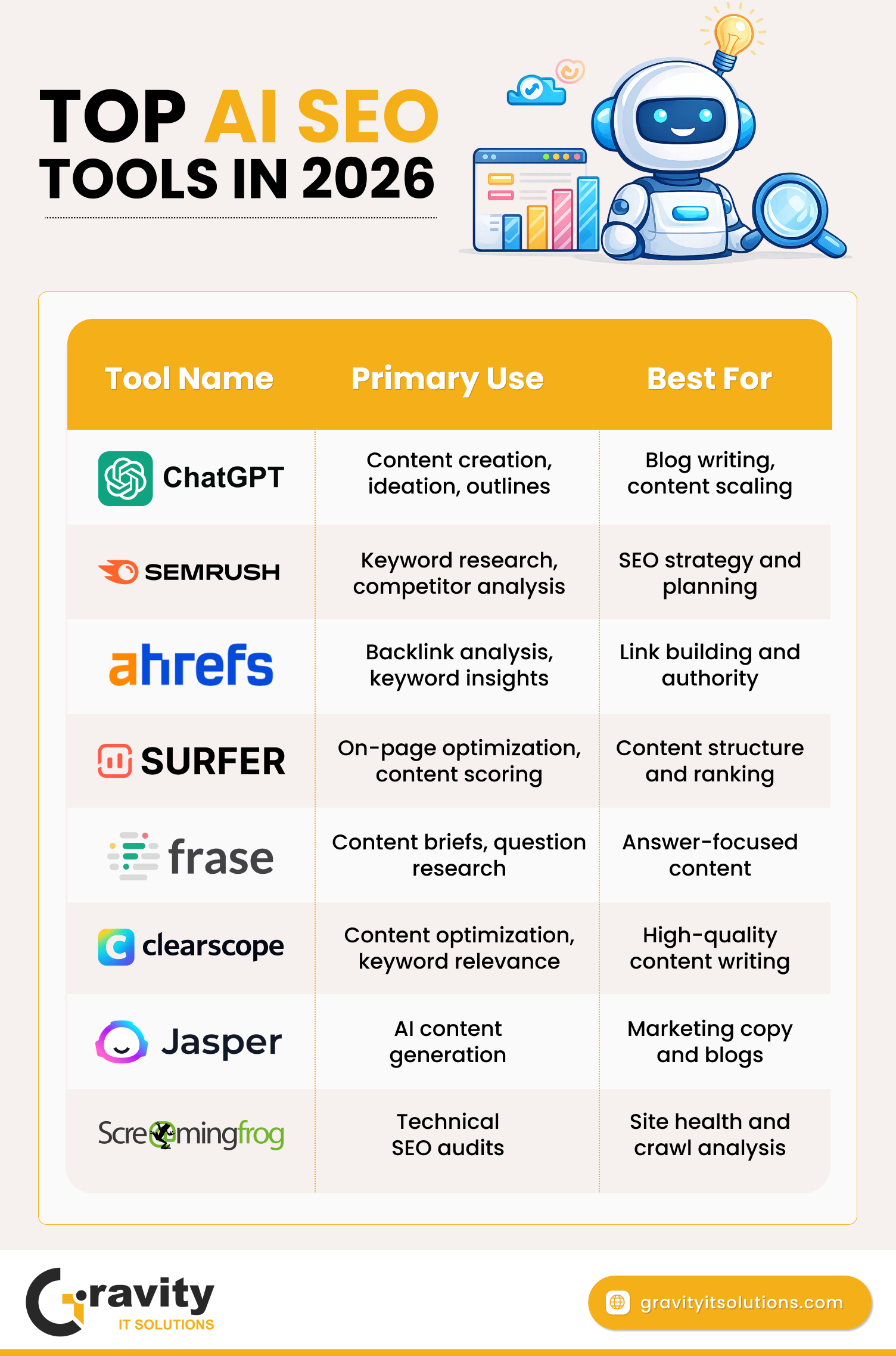
Comparison of AI SEO Tools
|
Tool |
Primary Use |
Best For |
|
ChatGPT |
Content creation |
Drafting and ideation |
|
SEMrush |
Keyword + competitor analysis |
Strategy planning |
|
Ahrefs |
Backlinks + keyword insights |
Authority building |
|
Surfer SEO |
On-page optimization |
Content structure |
|
Frase |
Content research |
Answer-focused content |
How to Choose the Right Tools
Selecting the right tools depends on your goals and resources.
Consider:
-
Your primary focus (content, technical SEO, or analytics)
-
Budget and scalability
-
Integration with existing workflows
For most businesses, a combination of tools works best. For example:
-
ChatGPT for content creation
-
SEMrush or Ahrefs for research
-
Surfer SEO for optimization
Real Use Cases of AI SEO
Understanding AI SEO concepts is important, but seeing how they are applied in real scenarios makes the impact much clearer.
AI SEO is not limited to one industry. It is being used across different business models to improve visibility, attract targeted audiences, and drive conversions.
Below are some practical use cases that demonstrate how AI SEO works in real-world situations.
E-commerce Businesses
E-commerce websites rely heavily on search visibility to drive product discovery and sales.
How AI SEO helps:
-
Identifies high-intent keywords based on buying behavior
-
Optimizes product descriptions for both users and AI systems
-
Enhances product visibility in AI-generated recommendations
Example:
An online store selling fitness equipment can use AI to identify queries such as:
“best home gym equipment for beginners”
Instead of just listing products, the website can create structured content that includes:
-
Product comparisons
-
Buying guides
-
Clear answers to common questions
This increases the chances of being featured in AI-generated summaries and improves conversion rates.
Local Businesses (USA Market Focus)
Local businesses benefit significantly from AI SEO, especially in competitive markets like the United States.
How AI SEO helps:
-
Improves visibility in location-based searches
-
Enhances content for conversational queries
-
Optimizes business information for AI-driven platforms
Example:
A digital marketing agency targeting businesses in the USA can optimize for queries such as:
“best SEO agency for small businesses in the USA”
By creating content that includes:
-
Service explanations
-
Case studies
-
Location-specific insights
The business increases its chances of appearing in both traditional search results and AI-generated answers.
SaaS Companies
Software-as-a-Service (SaaS) companies operate in highly competitive digital environments where content plays a key role in customer acquisition.
How AI SEO helps:
-
Targets problem-based and solution-driven queries
-
Creates in-depth content for different stages of the buyer journey
-
Improves visibility in AI-generated recommendations
Example:
A CRM software company can target queries like:
“best CRM for startups”
Instead of just promoting features, the company can create:
-
Detailed comparison pages
-
Use-case-based content
-
Step-by-step guides
This approach helps the content get selected by AI systems when generating recommendations.
Content Publishers and Blogs
Content-driven websites benefit from AI SEO by increasing reach and engagement.
How AI SEO helps:
-
Identifies trending topics early
-
Optimizes content for AI-generated summaries
-
Improves content structure for better readability
Example:
A blog focused on digital marketing can use AI tools to identify trending topics such as:
“AI in SEO trends 2026”
By publishing well-structured and informative content early, the blog can capture traffic and gain visibility in AI-powered search features.
Service-Based Businesses
Service providers can use AI SEO to attract high-quality leads.
How AI SEO helps:
-
Targets specific service-related queries
-
Builds authority through informative content
-
Improves conversion through clear messaging
Example:
An SEO agency can create content around:
“AI SEO strategy for small businesses”
By including:
-
Clear explanations
-
Step-by-step strategies
-
Real examples
The business positions itself as an authority and increases the likelihood of attracting qualified leads.
Challenges of AI in SEO
While artificial intelligence offers significant advantages in search engine optimization, it also introduces new challenges that businesses must carefully navigate.
Understanding these challenges is essential to building a balanced and sustainable AI SEO strategy.
Over-Reliance on AI-Generated Content
One of the most common issues is the excessive use of AI for content creation without proper human oversight.
AI tools can generate content quickly, but they often lack:
-
Original insights
-
Real-world experience
-
Deep subject expertise
As a result, content may become generic, repetitive, or less engaging.
Best practice:
Leverage AI to assist your workflow, not to fully replace human input. Combine AI-generated drafts with human editing, expertise, and personalization to maintain quality and authenticity.
Decline in Organic Clicks (Zero-Click Impact)
AI-powered search features often provide answers directly on the search results page, reducing the need for users to click on websites.
This can lead to:
-
Lower organic traffic
-
Reduced click-through rates
-
Increased competition for visibility within AI-generated answers
Best practice:
Focus on visibility beyond clicks. Optimize content to appear in AI-generated summaries and build strong brand recognition so users seek out your business directly.
Content Quality and Accuracy Issues
AI-generated content can sometimes include:
-
Inaccurate information
-
Outdated data
-
Misinterpretations of complex topics
This can harm credibility and trust if not properly reviewed.
Best practice:
Ensure all content is fact-checked, updated regularly, and supported by reliable sources. Accuracy and trustworthiness are critical for both users and AI systems.
Increased Competition
AI tools are widely accessible, making it easier for businesses to produce content at scale.
This leads to:
-
Content saturation
-
More competition for the same keywords and topics
-
Difficulty in standing out
Best practice:
Focus on creating unique, high-value content that includes:
-
Original insights
-
Case studies
-
Practical examples
Differentiation is key to maintaining a competitive advantage.
Complexity of AI-Driven Search Algorithms
AI-powered search systems are constantly evolving and becoming more complex.
This makes it challenging to:
-
Predict ranking factors
-
Understand how content is selected for AI-generated answers
-
Maintain consistent performance
Best practice:
Stay updated with industry trends, continuously test strategies, and adapt based on performance data.
Measurement Challenges
Traditional SEO metrics such as rankings and traffic no longer provide a complete picture of performance.
With AI-driven search:
-
Visibility may increase without corresponding traffic
-
Content may influence users without direct clicks
-
New metrics are required to evaluate success
Best practice:
Monitor a wider range of performance metrics, such as:
-
Impressions and visibility
-
Brand mentions
-
Engagement metrics
-
Presence in AI-generated answers
Future of AI and SEO
Artificial intelligence is not a temporary trend in search — it is the foundation of how search will continue to evolve in the coming years.
As AI technologies become more advanced, the way users discover information and the way search engines deliver results will continue to change. Businesses that understand these trends early will be better positioned to maintain and grow their online visibility.
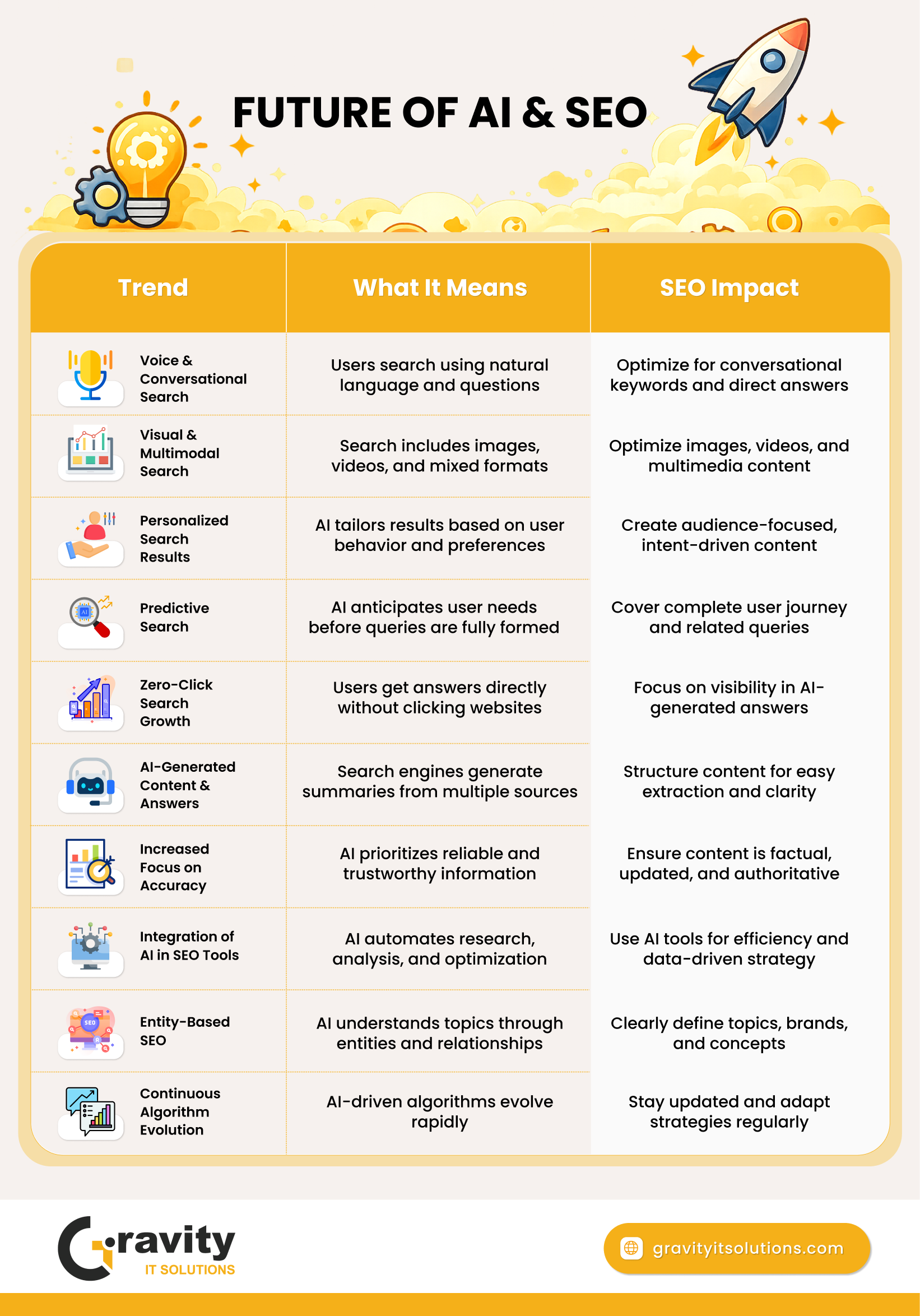
Rise of Voice and Conversational Search
Voice search and conversational queries are becoming more common as users interact with AI assistants and smart devices.
Instead of typing short keywords, users now ask detailed questions such as:
-
“What is the best SEO strategy for a small business?”
-
“How can I improve website traffic using AI?”
This shift requires content that:
-
Uses natural, conversational language
-
Answers questions clearly and directly
-
Covers follow-up queries within the same content
Optimizing for conversational search will become increasingly important as AI continues to shape user behavior.
Growth of Visual and Multimodal Search
Search is no longer limited to text. AI is enabling search engines to understand images, videos, and other media formats.
This means:
-
Images and videos will play a larger role in SEO
-
Content must be optimized across multiple formats
-
Visual elements will contribute to search visibility
For example, product searches may include image-based results, while tutorials may prioritize video content alongside written guides.
Increased Personalization in Search Results
AI allows search engines to deliver highly personalized results based on user behavior, preferences, and context.
This leads to:
-
Different users seeing different search results for the same query
-
Content tailored to specific audiences becoming more effective
-
Greater importance of user experience and engagement
Businesses must focus on understanding their target audience and creating content that meets specific needs.
Predictive Search and User Intent
AI is moving toward predicting user needs before they are fully expressed.
Search engines are becoming better at:
-
Anticipating user questions
-
Suggesting relevant topics
-
Delivering proactive recommendations
This requires content strategies that:
-
Cover the complete user journey
-
Address both primary and secondary queries
-
Provide comprehensive solutions
Greater Focus on Accuracy and Trust
As AI-generated content becomes more widespread, search engines are placing greater emphasis on accuracy and reliability.
Content that is:
-
Well-researched
-
Factually correct
-
Supported by credible sources
will have a higher chance of being featured in AI-generated answers.
Trust signals, such as expertise and authority, will continue to play a critical role in SEO success.
Integration of AI Across All SEO Processes
AI will increasingly be integrated into every aspect of SEO, including:
-
Content creation and optimization
-
Keyword research and trend analysis
-
Technical SEO and site performance
-
Data analysis and reporting
This integration will make SEO more efficient but also more competitive, requiring businesses to adopt advanced strategies.
What This Means for Businesses
The future of AI and SEO highlights several key priorities:
-
Focus on creating high-quality, user-centric content
-
Optimize for multiple search formats (text, voice, visual)
-
Build strong authority and trust
-
Adapt to continuous changes in search algorithms
-
Use AI as a strategic tool rather than a complete solution
Businesses that align with these priorities will be better equipped to succeed in an AI-driven search environment.
Is AI Replacing SEO?
As artificial intelligence continues to transform search, a common question arises: Is AI replacing SEO?
The short answer is no. AI is not replacing SEO — it is reshaping and expanding it.
SEO is Evolving, Not Disappearing
Search engines still rely on core SEO principles such as:
-
Content relevance
-
Technical optimization
-
Authority and trust
However, the way these factors are evaluated has changed significantly due to AI.
Instead of focusing only on rankings, modern SEO now includes:
-
Visibility in AI-generated answers
-
Content clarity and structure
-
Entity understanding and context
This means SEO is becoming more advanced, not obsolete.
The Role of AI in Modern SEO
AI acts as an enhancement layer over traditional SEO practices.
It helps:
-
Interpret user intent more accurately
-
Analyze large amounts of data quickly
-
Deliver more relevant and personalized results
For businesses, this means SEO strategies must adapt to how AI processes and presents information.
Human Expertise Still Matters
While AI can automate many tasks, it cannot fully replace human expertise.
High-quality SEO still depends on:
-
Original insights and experience
-
Strategic thinking
-
Understanding audience needs
-
Creating engaging and trustworthy content
AI can assist with efficiency, but human input ensures quality and authenticity.
Example: SEO with and without AI
Without AI:
-
SEO focuses on keyword optimization and backlinks
-
Content is created primarily for search engines
With AI:
-
SEO focuses on user intent and context
-
Ensure your content is well-organized for both human readers and AI algorithms
-
Visibility includes AI-generated summaries and answers
This demonstrates that AI enhances SEO rather than replacing it.
The New Definition of SEO
SEO is no longer just about ranking pages on search engines.
It is now about:
-
Being discoverable across multiple platforms
-
Providing accurate and valuable information
-
Becoming a trusted source for both users and AI systems
This broader approach reflects the integration of AI into search.
What Businesses Should Focus On
To succeed in this evolving landscape, businesses should:
-
Combine traditional SEO fundamentals with AI-driven strategies
-
Prioritize content quality, clarity, and structure
-
Build authority and trust within their niche
-
Continuously adapt to changes in search technology
Those who embrace this evolution will be better positioned to maintain visibility and growth.
Frequently Asked Questions (FAQs)
What is AI SEO?
AI SEO is the process of optimizing content so it can be understood, selected, and displayed by AI-powered search systems. It focuses on improving visibility not only in traditional search results but also in AI-generated answers and summaries.
How does AI impact SEO?
AI impacts SEO by changing how search engines understand and deliver results. Instead of relying only on keywords, AI analyzes user intent, context, and content quality. It also enables features like AI-generated summaries, which reduce reliance on traditional rankings.
What is generative AI SEO?
Generative AI SEO focuses on optimizing content for AI-generated responses. It ensures that content is clear, structured, and accurate so that AI systems can easily extract and use it when generating answers for users.
Is AI replacing SEO?
No, AI is not replacing SEO. It is transforming how SEO works. While traditional methods like keyword optimization and technical SEO are still important, they must now be combined with AI-focused strategies such as content structure, clarity, and entity optimization.
What are the best ways to optimize content for AI-driven search?
To optimize content for AI search, focus on:
-
Providing clear and direct answers
-
Structuring content with headings and lists
-
Using natural language and conversational tone
-
Ensuring factual accuracy and reliability
-
Building topical authority and strong internal linking
These practices help AI systems better understand and use your content.
Do keywords still matter in AI SEO?
Yes, keywords still matter, but their role has evolved. Instead of focusing on exact keyword matches, AI SEO emphasizes intent, context, and semantic relevance. Keywords should be used naturally within meaningful and informative content.
What are the best tools for AI SEO?
Some of the most effective AI SEO tools include:
-
ChatGPT for content creation and ideation
-
SEMrush for keyword research and competitor analysis
-
Ahrefs for backlink and keyword insights
-
Surfer SEO for on-page optimization
-
Frase for content research and question-based optimization
These tools help improve efficiency and support data-driven SEO strategies.
What is zero-click search?
Zero-click search occurs when users find answers directly on the search results page without clicking on any website. This is increasingly common due to AI-generated summaries, featured snippets, and knowledge panels.
How do I measure success in AI SEO?
Success in AI SEO should be measured using a broader set of metrics, including:
-
Visibility in AI-generated answers
-
Impressions and reach
-
Brand mentions and recognition
-
Engagement metrics
-
Organic traffic and conversions
Focusing only on rankings is no longer sufficient.
What is the future of AI in SEO?
The future of AI in SEO includes:
-
Increased use of voice and conversational search
-
Growth of visual and multimodal search
-
Greater personalization of search results
-
Stronger emphasis on content accuracy and trust
Businesses that adapt to these trends will have a competitive advantage in search visibility.
Conclusion
AI is transforming how search works, but the core goal remains the same — delivering valuable, accurate, and relevant information to users.
By combining traditional SEO fundamentals with AI-driven strategies, businesses can build a strong and sustainable presence in the evolving search landscape.

Pankaj Mehta
Pankaj Mehta, CEO of Gravity IT Solutions, brings over 19 years of experience in digital transformation. His strategic leadership drives global growth through innovative web, app, and marketing solutions, leveraging AI, cloud, and SEO to maximize ROI and brand visibility.